

Laminoplasty vs. Spinal Fusion: How to Know Which Surgery Is Right for You
A hand that won’t quite cooperate, a grip that keeps slipping, numbness that spreads instead of fading. These are the moments that send people to a spine specialist, and they’re often the moments that end with one word: surgery. But hearing that word doesn’t mean there’s only one path forward.
Laminoplasty and spinal fusion are the two most common procedures for cervical spine compression, and they solve the same problem in completely different ways. Laminoplasty opens up room for the spinal cord while keeping your neck’s natural motion intact. Fusion locks vertebrae together for stability, trading some motion for a more permanent fix. The right one for you depends on your spine, not a one-size-fits-all protocol.
Quick Summary:
- Laminoplasty relieves spinal cord pressure by restructuring the lamina bone rather than fusing vertebrae, preserving neck motion
- Spinal fusion permanently joins vertebrae using bone grafts and hardware to stabilize the spine and eliminate painful motion
- The right procedure depends on spinal alignment, how many levels are affected, and whether significant neck pain is present
- Laminoplasty generally has a faster recovery timeline than spinal fusion
- Both procedures can achieve comparable neurological outcomes when matched to the right patient
What Is Laminoplasty Surgery?
Laminoplasty is a decompression procedure performed on the cervical spine that relieves pressure on the spinal cord by creating more room inside the spinal canal without removing bone or fusing vertebrae.
Think of it like a door on a hinge. The surgeon cuts through one side of the lamina (the bony arch protecting the back of your spinal canal) and creates a groove on the other, then swings the bone outward and props it open. The spinal cord gets more room, and because the bone stays in place, the spine keeps most of its natural motion. Most patients report meaningful recovery of nerve function within months of the procedure. Laminoplasty works best when multiple spinal levels are affected (typically three or more) and when the cervical spine maintains its normal lordotic curve.
What Is Spinal Fusion Surgery?
Spinal fusion permanently joins two or more vertebrae using bone grafts and often screws and rods, so they heal into a single solid unit. Eliminating motion at the fused segment is the goal: when that motion is the source of pain or instability, removing it resolves the problem.
Fusion treats conditions including degenerative disc disease, herniated discs, spondylolisthesis, spinal instability, and spinal deformity. It’s also often the right call when significant neck pain accompanies spinal cord compression, since laminoplasty preserves motion and won’t address pain driven by movement.
How Is Laminoplasty Different from Laminectomy?
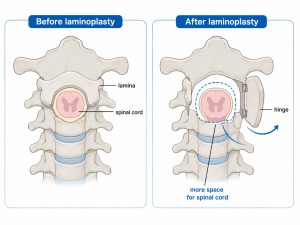
These two procedures are not the same. Laminectomy removes the lamina entirely to decompress the spinal cord. Laminoplasty hinges the lamina open and props it in place, creating space without removing bone. Keeping the structural elements intact lowers the risk of postoperative instability and typically avoids the need for fusion that laminectomy often requires.
What Does Cervical Spine Surgery Recovery Look Like?
For laminoplasty, most patients stay in the hospital one to three days. Most patients wear a neck collar for a few weeks after surgery and return to light activities within four to six weeks. Full recovery typically takes six to twelve weeks, with nerve recovery continuing for several months.
Fusion recovery moves more slowly because the bone graft needs time to solidify. Most patients return to a desk job within two to four weeks, but physically demanding work often requires three to six months. Full bone fusion takes three to six months and can extend to a year, with formal physical therapy beginning around six to twelve weeks once your surgeon confirms initial healing.
The key difference is that fusion recovery isn’t just about healing from surgery. It’s about waiting for two vertebrae to biologically grow into one.
How Does a Surgeon Decide Which Procedure to Recommend?
Research published in the Journal of Neurosurgery Spine confirms that surgeons generally favor fusion when a patient has significant pre-existing neck pain, kyphosis (an abnormal forward curve of the cervical spine), or spinal instability. Laminoplasty is better suited when the spine maintains normal lordotic curvature, multiple levels are affected, and symptoms are primarily neurological, such as weakness, numbness, or coordination problems, rather than neck pain.
The four factors that drive the decision:
- Number of levels: laminoplasty is preferred for disease affecting three or more vertebral segments
- Spinal alignment: kyphosis points toward fusion; normal lordosis supports laminoplasty
- Neck pain: significant pre-existing neck pain favors fusion, since preserved motion won’t resolve movement-driven pain
- Stability: instability or significant movement between vertebrae requires fusion
Research published in PMC shows both procedures achieve similar neurological outcomes for multilevel cervical myelopathy — the differences lie in motion preservation, recovery speed, and patient selection.
Is One Procedure Better Than the Other?
Neither is universally better. Laminoplasty preserves motion and offers faster recovery. Fusion provides greater stability and better pain relief when axial neck pain is present. According to HSS, the recommendation comes from a thorough assessment of your imaging, alignment, and symptoms, not from a standard protocol applied to every patient.
Frequently Asked Questions
Will I lose neck motion after spinal fusion?
Yes, to some degree at the fused levels. Fusion eliminates motion between the joined vertebrae, which makes it effective for instability and pain driven by movement. Most patients adapt well, and many report that the reduction in pain is worth the trade-off. Physical therapy after surgery helps restore as much functional movement as possible in the surrounding segments.
Can laminoplasty fail or stop working over time?
Laminoplasty is generally durable and reliably halts the progression of cervical myelopathy in most patients. Nerve recovery depends in part on how long the spinal cord was compressed before surgery. It’s worth knowing that laminoplasty doesn’t address spinal instability or arthritis-driven neck pain, so if those issues develop after surgery, additional treatment may be needed.
What symptoms should prompt me to see a spine specialist?
Numbness or tingling in your hands or arms, weakness in your grip, trouble with balance or coordination, or neck pain that radiates into the arms and keeps worsening despite conservative care are all worth getting evaluated. These can indicate cervical myelopathy or significant nerve compression that won’t improve on its own. An orthopedic spine specialist can review your imaging and symptoms to determine whether surgery is indicated and which approach fits your situation.
The Right Procedure Starts With the Right Evaluation
Choosing between laminoplasty and spinal fusion comes down to your specific spine: your alignment, your symptoms, how many levels are involved, and what you need from surgery. Getting a thorough evaluation from a surgeon who performs both procedures is the most important step you can take.
Talk to a Spine Specialist at Palmetto Bone & Jointat Palmetto Bone & Joint
Dr. Samuel Davis, Palmetto Bone & Joint’s spine specialist, trained at Duke and Emory universities and is the only surgeon in the Midlands of South Carolina performing cervical laminoplasty surgery. He offers both laminoplasty and spinal fusion and works with each patient individually to find the right approach.
Call us at (803) 902-3169 or contact us online to schedule an evaluation at our Chapin, Irmo, or Newberry locations.
Related Posts

Why Fall Is the Smartest Time to Schedule Your Joint Replacement Surgery
If you’ve been managing joint pain through another summer and telling yourself you’ll deal with…
Cartilage Defects 101: What They Are and Why Early Treatment Matters
A cartilage defect is a localized area of damage to the smooth, protective surface that…

Carpal Tunnel vs. De Quervain’s: How to Tell Which One Is Causing Your Hand Pain
Carpal tunnel syndrome and De Quervain’s tenosynovitis both cause hand and wrist pain, and they’re…